werkrbee / the ai-hive
From nectar
to AI agents.
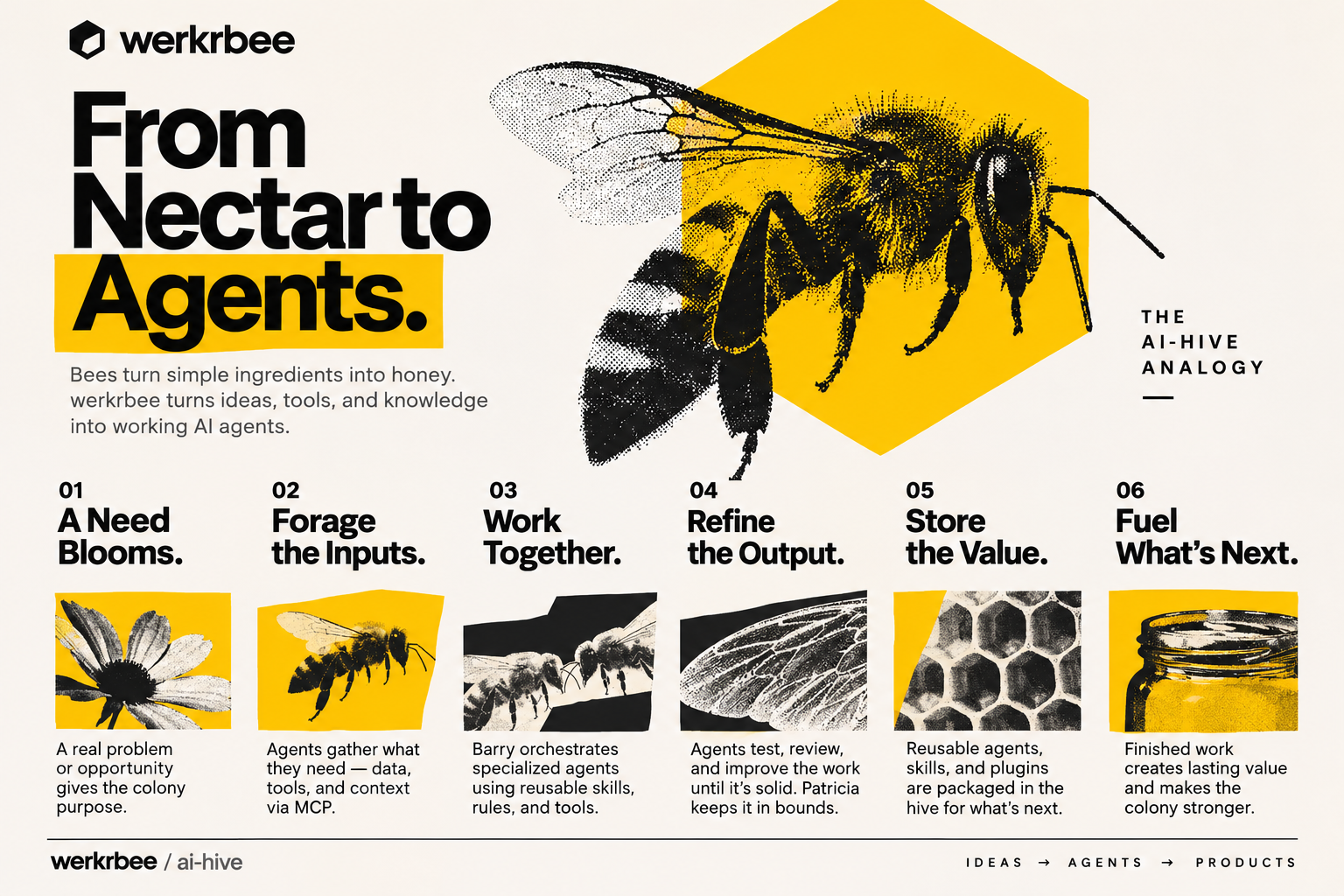
Bees turn simple ingredients into honey. werkrbee turns human goals, tools, knowledge, and instructions into reusable AI capabilities—and carries what works into products.
The idea behind the hive
Build the factory.
Then build the product.
Many AI projects begin with a prompt and solve one task. The ai-hive is built around reusable parts: skills, tools, instructions, specialized agents, workflows, and knowledge.
Bring those parts together around a human goal, and the work can become a product. When a product teaches us something, that learning can strengthen the shared foundation for the next one.
A six-stage way to see it
From a real need
to lasting value.
- 01
A need blooms.
A problem, opportunity, or idea gives the colony a purpose. The human goal is the flower: it tells the work where to begin.
- 02
Forage the inputs.
Agents gather the context and capability a task needs.
mcp-hiveorganizes tool connections;knowledge-hivegives projects a place for state and memory. - 03
Work together.
Barry breaks a goal into work, delegates to specialized agents, and brings results together. Saved workflows make repeatable work easier to resume.
- 04
Refine the output.
Skills and shared rules guide how the work is done. Patricia governs the colony’s boundaries, while people remain accountable for the outcome.
- 05
Store what works.
Reusable artifacts are versioned and packaged.
plugins-hivebundles capabilities;projects-hiveassembles them for a new initiative. - 06
Fuel what’s next.
Lineup is the first product the ai-hive runs through the factory. What the work teaches can improve the reusable foundation for future products.
Who does what inside the hive?
A colony of distinct roles.
One human purpose.
| Bee colony | werkrbee ai-hive | The role |
|---|---|---|
| Queen bee | Patricia · rules-hive | Governance, shared rules, and the colony charter. |
| King bee | Barry · orchestration | Decomposes goals, delegates work, and synthesizes results. |
| Worker bees | Agent harnesses · agents-hive | Specialized agents and the environments where they work. |
| Foraging | mcp-hive | Tool and service connections that let agents act. |
| Bee instincts | skills-hive | Reusable capabilities and ways of working. |
| Colony rhythm | workflows-hive | Durable, resumable plans for multi-step work. |
| Honeycomb | plugins-hive · projects-hive | Bundles that package capabilities and scaffolds that assemble them. |
| Stored knowledge | knowledge-hive | Project state, memory, results, and usage records. |
| Honey | Products and completed work | Value created for people, using what the colony has learned. |
The deeper analogy
We’re building better beehives.
The goal is not to make one jar of honey. It is to build a portable, reusable foundation that helps the next product start with more of what already works. The bee colony is an analogy; the ai-hive itself is a set of versioned artifacts designed to work across agent harnesses.
People still own the house. Human judgment sets the purpose and remains part of the governance.